Perplexity at Maybe*
Perplexity is one of the models Maybe* uses when your work requires fast, accurate retrieval and up-to-date information from across the web.
It specialises in gathering external knowledge, checking facts, and producing grounded answers. Your Agent will choose Perplexity when a task requires research, verification, or context that lives outside your internal systems.
You do not need to choose the model yourself. When your Agent recognises that a question calls for external information, it will route the request to Perplexity automatically.
How Maybe* Uses Perplexity
Perplexity is often chosen when your Agent needs to:
Find accurate information quickly
Gather up to date facts from the public web
Compare multiple external sources
Verify claims or clarify uncertain details
Build grounded summaries based on current information
From your perspective, nothing changes. You still work in Slack, Teams, or your usual tools and say things like:
“@Maybe research this topic and give me a summary.”
“@Maybe compare these products and highlight the key differences.”
“@Maybe fact check this statement and tell me what is confirmed.”
Behind the scenes, the orchestration Agent may choose Perplexity to handle that work.
Where Perplexity Shines
Research and discovery
Fast retrieval of relevant information
Clear summaries of broad or unfamiliar topics
Strong at identifying the most useful sources
Use it for: early research, briefing packs, competitive landscapes, quick learning.
Fact checking and verification
Cross-references claims across available sources
Highlights what is confirmed and what is uncertain
Produces grounded, citation-based answers
Use it for: content validation, due diligence, accuracy checks before publishing.
Comparison and evaluation
Gathers information across multiple public sources
Produces clean comparisons and structured insights
Identifies similarities, differences, and tradeoffs
Use it for: vendor comparisons, product research, market scanning.
Trend and sentiment awareness
Surfaces recent developments and shifting viewpoints
Helps build a picture of what is happening now
Provides context that other models may not have
Use it for: staying updated on industry changes, tracking new competitors, scanning emerging ideas.
Supporting contextual writing
Supplies up to date factual grounding for longer content
Helps prepare inputs for deeper reasoning by other models
Reduces the risk of outdated or incorrect assumptions
Use it for: reports, strategy documents, analysis that depends on real time information.
Specialised strengths
Perplexity stands out in the areas where fast, grounded research matters most.
It is particularly strong at gathering information from across the web, identifying relevant details, and presenting them in a clear and useful way. When your team needs accurate context or reliable background information, Perplexity helps your Agent produce outputs you can trust.
Perplexity is also skilled at synthesising information from multiple sources.
It can read articles, documentation, public data, and research materials in a single request and merge them into a coherent narrative. This makes it a valuable partner for teams preparing briefs, comparisons, or exploratory research.
When the work involves clarifying uncertain topics, Perplexity shines here too.
It can highlight what is verified and what remains unclear, giving your team a balanced and transparent view. Whether you are exploring a new domain or reviewing claims, Perplexity keeps the output grounded.
It also supports discovery work.
Perplexity can refine broad queries and surface insights your team may not have considered. It helps your Agent uncover patterns, themes, or leads that support early stage thinking.
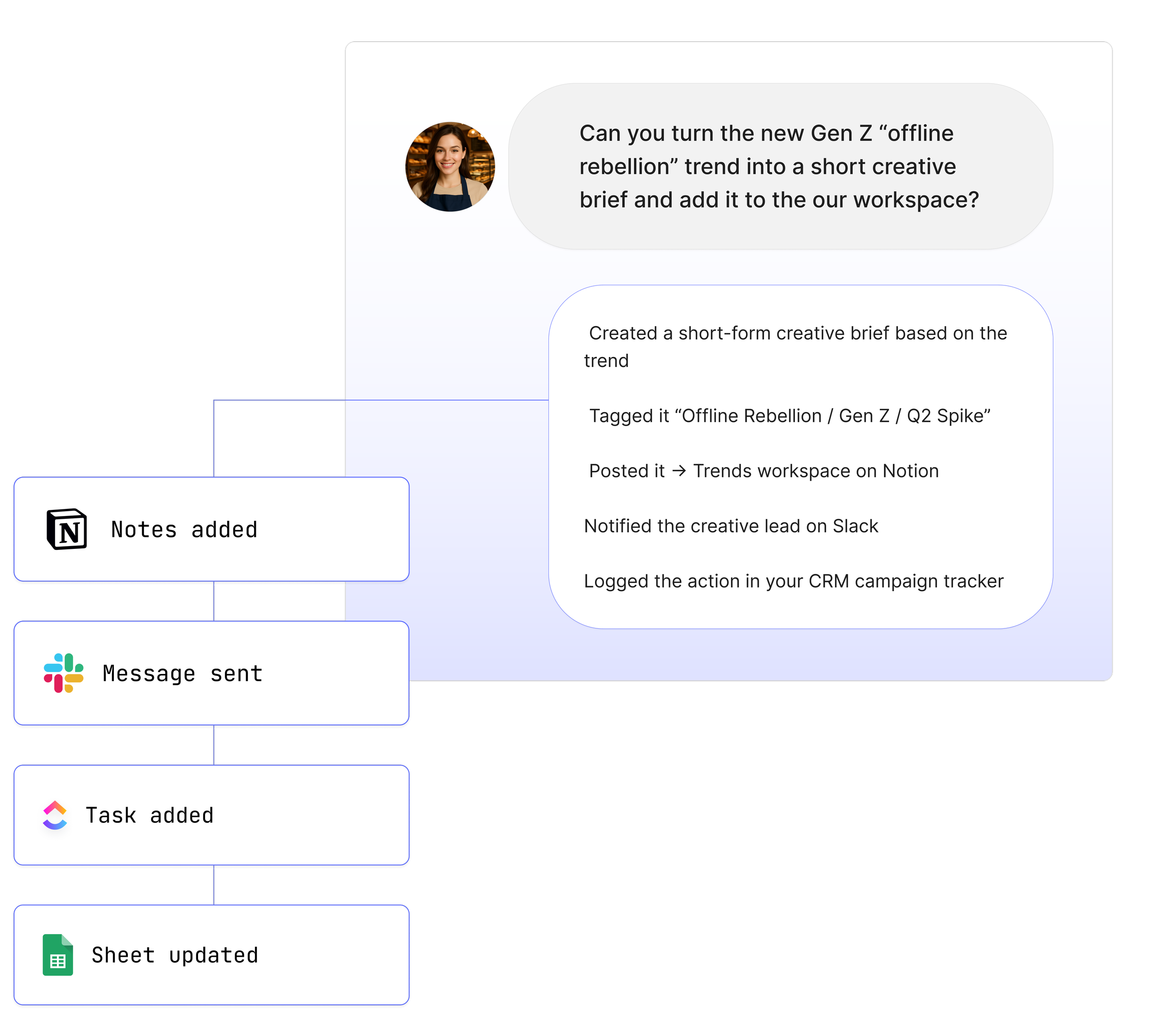
These strengths become even more useful when paired with other tools. Your Agent can use Perplexity to collect current information and place it directly into Google Docs, add insights into Sheets, enrich ClickUp tasks, or share results in Slack or Teams. Research flows smoothly into your existing workflows without manual searching or copy and paste.
How Perplexity Works With Other Models
Perplexity does not work alone inside Maybe*. It is one of several models your Agent can choose from. The orchestration layer watches the task you give it and decides which model is the best fit. Perplexity is often selected when the work depends on external information, factual grounding, or quick access to up-to-date sources.
Your Agent can also use Perplexity as a research layer. It gathers the relevant information first, then another model can process it, reason over it, or turn it into polished writing. This gives your team both accuracy and depth.
Sometimes speed and real-time knowledge are important. Sometimes, deeper analytical reasoning is more important. Perplexity is chosen for the former. When the request needs current information or careful verification, your Agent routes the work to Perplexity automatically.
From your perspective, the process stays simple. You speak to @Maybe in Slack, Teams, or your workspace. You do not choose the model. You do not manage prompts. Maybe* selects Perplexity when it is the right tool for the job and handles everything behind the scenes.
See How Teams Like Yours Are Using Maybe* Integrations

About Maybe*
Maybe* connects to the systems your team relies on every day so AI can handle real work end to end. Use Maybe* directly, or from Slack or Microsoft Teams. Wherever you work, our AI Agents bring the right context, take the right actions, and keep workflows moving.
Powered by our patent pending AI Agent Builder and orchestration layer, Maybe* chooses the right model and the right integration for each task. You do not need to configure prompts per model or build complex routing.
Begin with a single AI Agent and a few key tools. Add more models and integrations as you grow. Maybe* expands from simple automations to fully orchestrated, cross tool workflows.