Claude at Maybe*
Careful reasoning, long context, and clear explanations when it matters most
Maybe* uses multiple large language models behind the scenes. Our orchestration Agent selects the best one for each task. Claude is one of the models we rely on when your work needs deep reasoning, long context, or thoughtful analysis.
You do not need to choose Claude yourself. When your Agent sees a task that fits Claude’s strengths, it will route the request there automatically.
How Maybe* Uses Claude
Claude is often chosen when your Agent needs to:
Work through complex, multi step reasoning
Weigh tradeoffs and edge cases
Keep track of very long context
Produce careful explanations or structured outputs
Handle sensitive topics with extra care
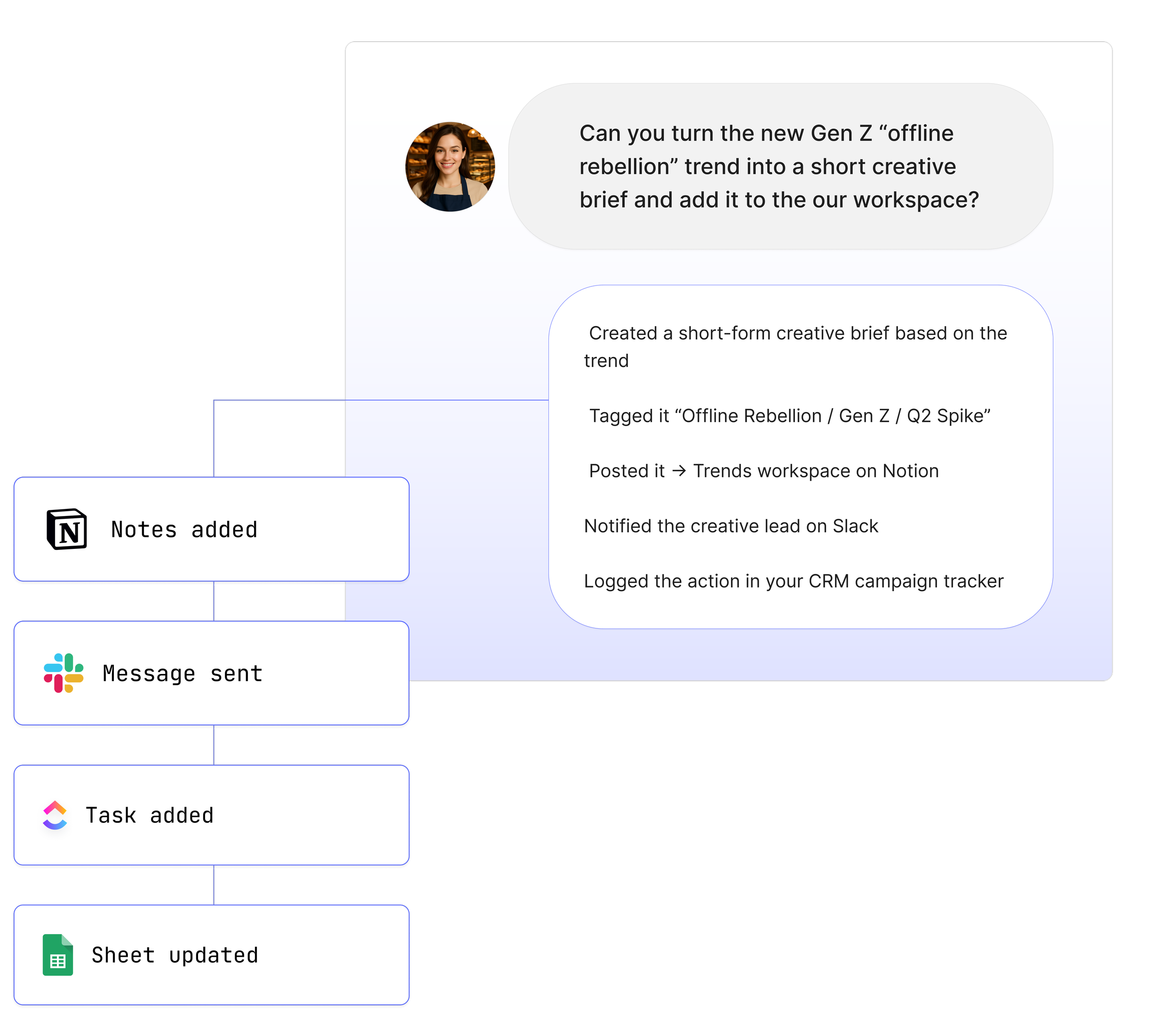
From your perspective, nothing changes. You still work in Slack, Teams, or your usual tools and say things like:
“@Maybe review this contract and highlight risks.”
“@Maybe walk me through the reasoning behind this recommendation.”
“@Maybe summarise these documents into a brief I can share.”
Behind the scenes, the orchestration Agent may choose Claude to handle that work.
Where Claude Shines
Reasoning and analysis
Nuanced, multi step reasoning
Strong at weighing tradeoffs and considering edge cases
Thoughtful handling of ambiguous or complex requests
Use it for: strategy documents, design decisions, tradeoff analysis, complex technical explanations.
Long context window
Supports very long inputs
Can work with entire codebases or large document sets in one call
Maintains coherence across long inputs
Use it for: long contracts, research packets, multi-file code reviews, and multi-meeting summaries.
Writing quality
Natural, human-sounding prose
Avoids generic or repetitive patterns
Good at matching tone and adapting style
Use it for: executive summaries, long-form explanations, internal docs, customer-facing drafts that need polish.
Code capabilities
Thorough code review and explanation
Careful debugging with clear, step-by-step reasoning
Clean, well-documented example code
Use it for: explaining unfamiliar code, proposing refactors, writing helper scripts, reviewing PRs with context from multiple files.
Safety and reliability
Designed to be less likely to invent details on factual questions
More likely to acknowledge uncertainty when the answer is unclear
Extra care around sensitive topics
Use it for: work where being cautious is more important than being fast, or where you want a second pass on critical content.
Instruction following
Strong at following complex, multi part instructions
Reliable structured output (JSON, tables, bullet structures)
Good at maintaining constraints over long outputs
Use it for: generating data structures, filling templates, producing consistent report formats, or feeding other systems.
Specialised strengths
Claude stands out in the areas where careful thinking and depth matter most.
It is particularly strong at working with long or complex documents, pulling out the key information, and presenting it in a clear and structured way. When your team needs document summarisation or detailed extraction, Claude handles the work with a level of precision that helps your Agent produce reliable results.
Claude is also skilled at synthesising research across multiple sources.
It can read a collection of documents, notes, or datasets and bring everything together into a single, coherent narrative. This makes it a valuable partner for teams preparing reports, strategy documents, or internal briefs that need to reflect many different viewpoints or inputs.
When the work involves explaining a difficult concept, Claude shines here too.
It can break ideas into simple language without losing the meaning. Whether your team is trying to understand a technical system, a legal clause, or a design decision, Claude produces explanations that are accessible, calm, and accurate.
It also brings depth to creative work.
Claude produces writing with style and nuance, giving your Agent the ability to create drafts that feel more human and more thoughtful.
These strengths become even more useful when paired with other tools. Your Agent can use Claude to analyse documents stored in Google Drive, add findings directly into Docs or Sheets, or update tasks in your project systems with clear, structured insights. The result is work that flows cleanly from one tool to another without manual rewrites or copying.
How Claude Works With Other Models
Claude does not work alone inside Maybe*. It is one of several models your Agent can choose from. The orchestration layer watches the task you give it and decides which model is the best fit. Claude is often selected when the work needs more careful reasoning, longer attention, or a second pass to validate information.
Your Agent can also use Claude as a second opinion. For important pieces of content or analysis, the orchestration layer may compare Claude’s output with another model to check consistency. If the two models disagree, your Agent can look deeper and produce a clearer, more supported answer.
Sometimes speed is important. Sometimes caution is more important. Claude is chosen for the latter. When the request needs thoughtfulness or detailed explanation, your Agent routes the work to Claude automatically.
From your perspective, the process stays simple. You speak to @Maybe in Slack, Teams, or your workspace. You do not choose the model. You do not manage prompts. Maybe* selects Claude when it is the right tool for the job and handles everything behind the scenes.
See How Teams Like Yours Are Using Maybe* Integrations


About Maybe*
Maybe* connects to the systems your team relies on every day so AI can handle real work end to end. Use Maybe* directly, or from Slack or Microsoft Teams. Wherever you work, our AI Agents bring the right context, take the right actions, and keep workflows moving.
Powered by our patent pending AI Agent Builder and orchestration layer, Maybe* chooses the right model and the right integration for each task. You do not need to configure prompts per model or build complex routing.
Begin with a single AI Agent and a few key tools. Add more models and integrations as you grow. Maybe* expands from simple automations to fully orchestrated, cross tool workflows.