Grok at Maybe*
Real-time awareness, fast iteration, and sharp reasoning for tasks that need up-to-date context.
Maybe* uses multiple large language models behind the scenes. Our orchestration Agent selects the best one for each task. Grok is one of the models we rely on when your work benefits from real-time context, fast iteration, direct explanations, or a more opinionated reasoning style.
You do not need to choose Grok yourself. When your Agent sees a task that fits Grok’s strengths, it will route the request there automatically.
How Maybe* Uses Grok
Grok is often chosen when your Agent needs to:
Access fresh or fast moving information
Deliver quick reasoning or rapid iteration cycles
Provide clear, direct answers to practical questions
Support tasks that benefit from concise analysis
Handle casual exploration or creative ideation
Work with real time signals where speed matters
From your perspective, nothing changes. You still work in Slack, Teams, or your usual tools and say things like:
“@Maybe give me a quick rundown of what is happening with this topic.”
“@Maybe summarise the latest information and tell me what matters.”
“@Maybe help me think through options for this idea.”
Behind the scenes, the orchestration Agent may choose Grok to handle that work.
Where Grok Shines
Real-time context and speed
Prioritises fresh, fast-moving information
Responds quickly and keeps iteration cycles short
Good for tasks that need immediacy
Use it for: rapid updates, topical summaries, market shifts, and quick decision cycles.
Straightforward reasoning
Explains ideas directly and without heavy structure
Good at producing clear, to-the-point analysis
Helpful for tasks that benefit from sharp conclusions
Use it for: option reviews, short recommendations, directional planning.
Creative exploration
Supports brainstorming and ideation
Comfortable proposing alternatives and unconventional options
Fast at exploring multiple directions
Use it for: early-stage thinking, content ideas, product concepts.
Conversational tone
Feels natural in quick back-and-forth interactions
Good for more casual or exploratory chat
Helpful when teams want fast understanding without long explanations
Use it for: Q&A, concept clarification, conversational workflows.
Lightweight problem solving
Strong at simple transformations
Good at code snippets, explanations, or quick checks
Ideal for tasks that do not require long context
Use it for: small utilities, clarifying logic, and simple debugging.
High availability and scale
Designed for frequent, rapid requests
Handles volume without slowing down
Supports teams that need many lightweight tasks completed efficiently
Use it for: bulk processing, repeated content transformations, and operational workflows.
Specialised strengths
Grok stands out in the areas where real-time context, speed, and direct reasoning matter most.
It is particularly strong at delivering fast answers that help your team stay aware of current information without slowing down. When you need quick overviews or fresh context, Grok helps your Agent support those workflows with clarity and pace.
Grok is also skilled at fast analysis.
It moves quickly through the reasoning process and delivers clear, pointed recommendations. This makes it useful for teams that want sharp conclusions, option reviews, or directional advice.
When the work involves creative exploration, Grok performs well.
It is comfortable generating ideas, exploring multiple angles, and suggesting unconventional approaches that help teams move past early roadblocks.
It also excels in conversational tasks.
Grok’s tone is engaging and dynamic, making it effective for Q&A, rapid clarification, or informal team workflows where speed and clarity matter more than long structured answers.
These strengths become even more powerful when paired with your internal tools.
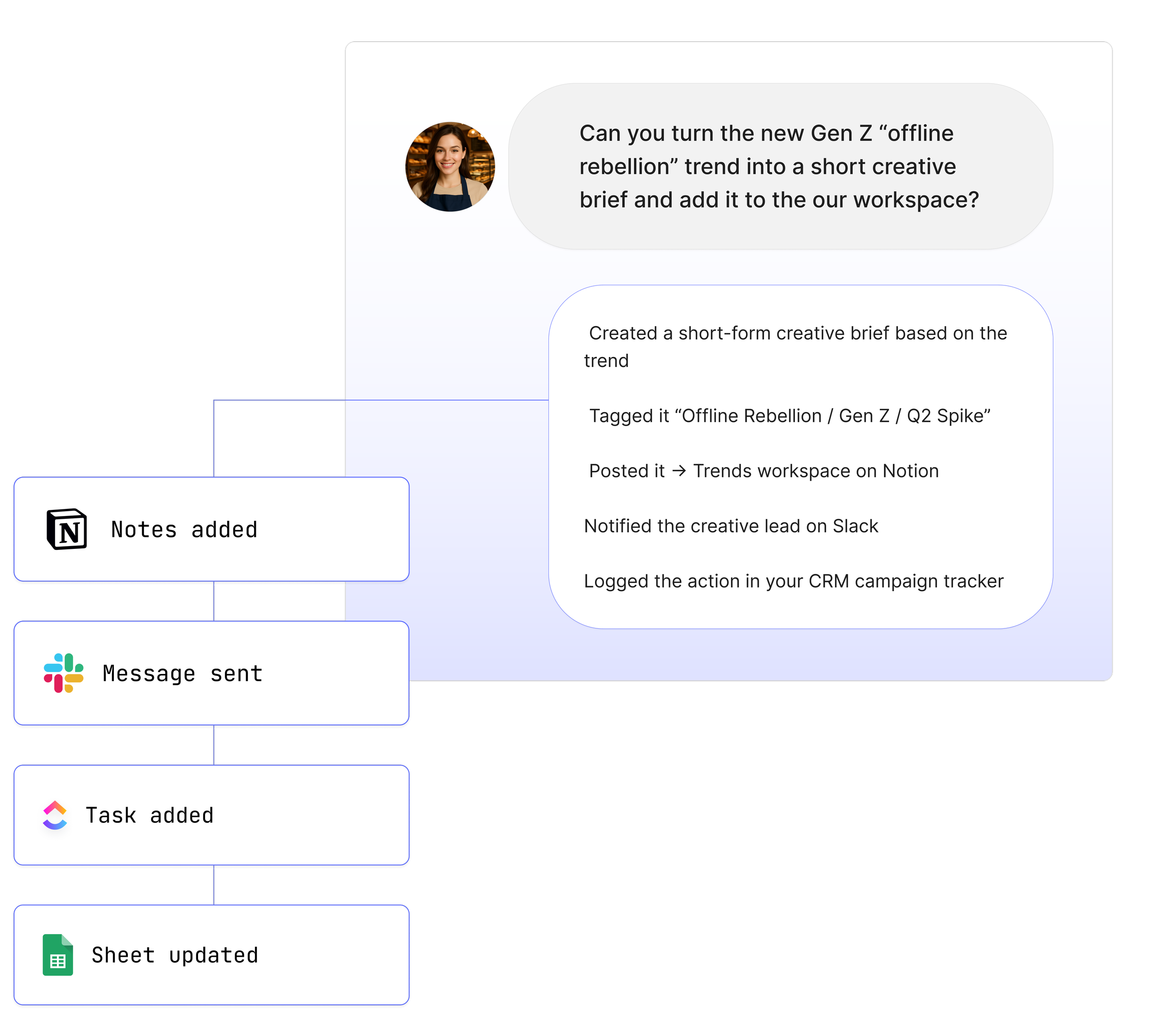
Your Agent can use Grok to explore ideas, gather quick context, summarise fast-moving topics, or generate draft content, then push results into Slack, Teams, Notion, Google Docs, or task systems without extra work.
How Grok Works With Other Models
Grok does not work alone inside Maybe*. It is one of several models your Agent can choose from. The orchestration layer watches the task you give it and decides which model is the best fit. Grok is often selected when the work needs quick iteration, conversational clarity, or awareness of fast-moving topics.
Your Agent can also use Grok as an initial pass. It can generate ideas or provide quick context that other models can refine, extend, or formalise. This allows Maybe* to blend speed with depth across multiple models.
Sometimes the task requires careful reasoning. Sometimes it requires long context. Sometimes it requires fast, current answers. Grok is chosen for the latter. When the request depends on speed or topical awareness, your Agent routes the work to Grok automatically.
From your perspective the process stays simple. You speak to @Maybe in Slack, Teams, or your workspace. You do not choose the model. You do not manage prompts. Maybe* selects Grok when it is the right tool for the job and handles everything behind the scenes.
See How Teams Like Yours Are Using Maybe* Integrations

About Maybe*
Maybe* connects to the systems your team relies on every day so AI can handle real work end to end. Use Maybe* directly, or from Slack or Microsoft Teams. Wherever you work, our AI Agents bring the right context, take the right actions, and keep workflows moving.
Powered by our patent pending AI Agent Builder and orchestration layer, Maybe* chooses the right model and the right integration for each task. You do not need to configure prompts per model or build complex routing.
Begin with a single AI Agent and a few key tools. Add more models and integrations as you grow. Maybe* expands from simple automations to fully orchestrated, cross tool workflows.