Balanced performance, strong reasoning, and versatile generation for everyday tasks
Maybe* uses multiple large language models behind the scenes. Our orchestration Agent selects the best one for each task. GPT is one of the models we rely on when your work needs balanced reasoning, reliable writing, strong general knowledge, or versatile generation across many formats.
You do not need to choose GPT yourself. When your Agent sees a task that fits GPT’s strengths, it will route the request there automatically.
How Maybe* Uses GPT
GPT is often chosen when your Agent needs to:
Produce clear, well-structured writing
Answer general questions with reliable reasoning
Support everyday workflows with balanced performance
Generate content across many formats
Help with coding tasks, explanations, or refactoring
Handle long-form tasks that require consistency and fluency
From your perspective, nothing changes. You still work in Slack, Teams, or your usual tools and say things like:
“@Maybe summarise this document and prepare a clean version for the team.”
“@Maybe help me outline this presentation.”
“@Maybe explain what this code does and suggest improvements.”
Behind the scenes, the orchestration Agent may choose GPT to handle that work.
Where GPT Shines
Balanced reasoning and writing
Strong general reasoning across many topics
Produces clear and fluent writing
Handles both short and long form tasks well
Use it for: summaries, reports, explanations, outlines, and internal documents.
Content creation
Good at generating structured, readable text
Supports many tones and styles
Helpful for drafts, rewrites, and ideation
Use it for: blog outlines, presentation content, marketing drafts, and knowledge articles.
Coding support
Strong debugging and code explanation
Helpful for refactoring and producing clean snippets
Supports multiple programming languages
Use it for: small utilities, code review help, and learning unfamiliar code.
General knowledge support
Broad understanding across many subjects
Helpful for conceptual explanations
Good for early research and idea exploration
Use it for: onboarding content, research notes, and conceptual breakdowns.
Structured output
Produces consistent JSON or table-based outputs
Good for workflows that rely on structured fields
Supports systems that require clean formatting
Use it for: data extraction, structured summaries, system instructions.
Adaptable tone
Can match brand voice with clear instructions
Supports professional, friendly, or simple styles
Good for customer-facing drafts
Use it for: communications, teaching materials, and help content.
Specialised strengths
GPT stands out in the areas where balanced reasoning, strong writing, and overall versatility matter most.
It is particularly strong at producing clear, coherent text that teams can use with little editing. When your organisation needs summaries, drafts, explanations, or structured content, GPT helps your Agent deliver results that feel polished and consistent.
GPT is also skilled at supporting a wide range of tasks.
It can write, explain, reason, and generate content across many formats without requiring specialised prompts. This makes it useful for teams that want dependable output across everyday workflows.
When the work involves coding or technical tasks, GPT performs well.
It can explain code, suggest improvements, and provide stable helper functions. It gives teams confidence when navigating unfamiliar systems or reviewing logic.
It also supports internal communication.
Teams can quickly turn rough notes into structured content that fits existing templates, guidelines, or formats. GPT handles the writing so your team can focus on the ideas.
These strengths become even more powerful when paired with your internal tools.
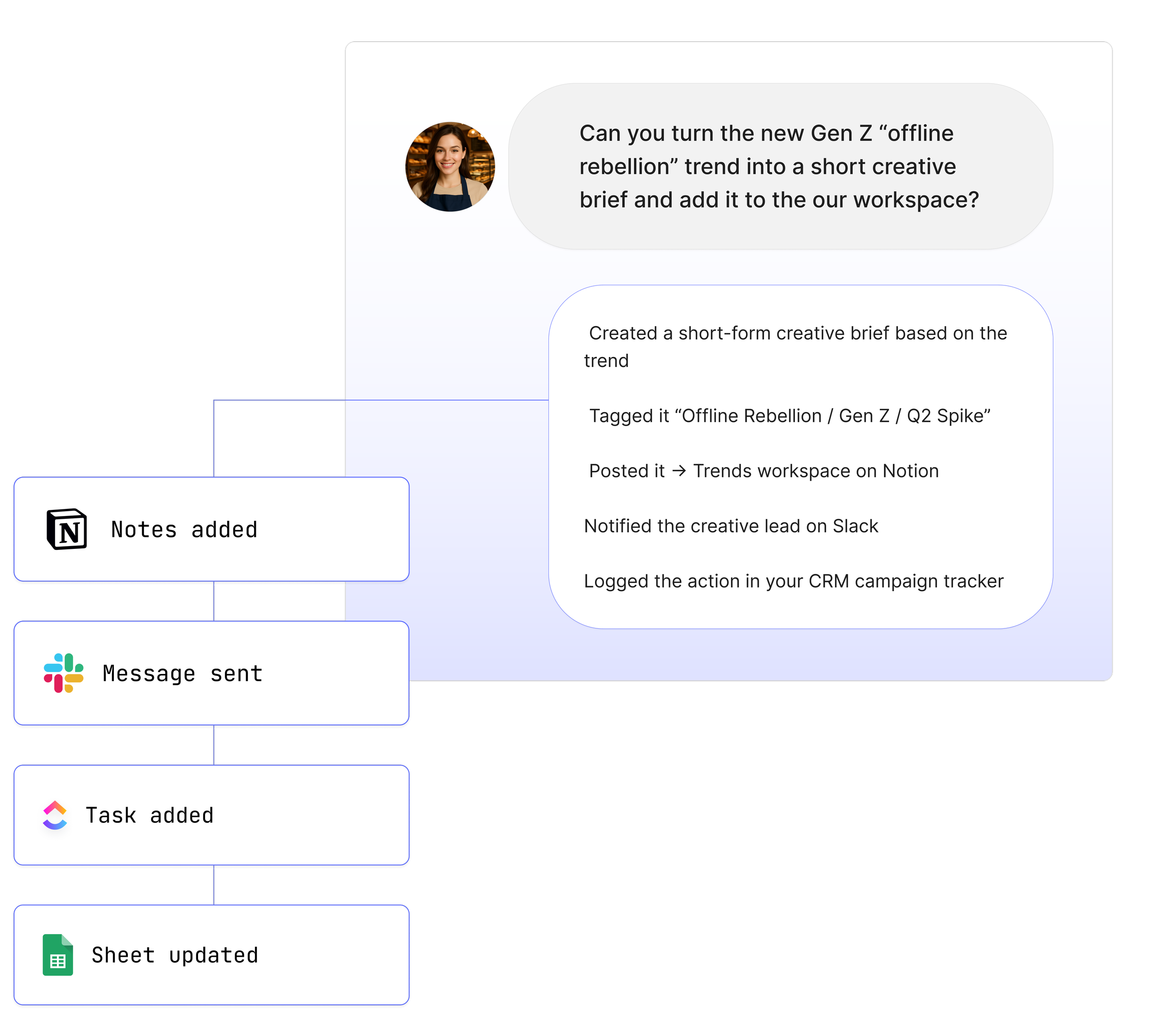
Your Agent can use GPT to create documents, write summaries, explain code, or organise information, then place the results directly into Google Docs, Sheets, ClickUp, Notion, Slack, or Teams. Your workflows become smoother and faster without additional manual work.
How GPT Works With Other Models
GPT does not work alone inside Maybe*. It is one of several models your Agent can choose from. The orchestration layer watches the task you give it and decides which model is the best fit. GPT is often selected when the work needs well rounded performance, strong writing, or stable reasoning across general topics.
Your Agent can also combine GPT with other models. One model may gather information or analyse a document, and GPT may refine the output into a clean, polished version. This allows Maybe* to blend strengths so your team receives both accuracy and clarity.
Sometimes the task requires long context. Sometimes it requires careful reasoning. Sometimes it requires fast processing. GPT is chosen when the work depends on strong writing, balanced reasoning, or adaptable output.
From your perspective, the process stays simple. You speak to @Maybe in Slack, Teams, or your workspace. You do not choose the model. You do not manage prompts. Maybe* selects GPT when it is the right tool for the job and handles everything behind the scenes.
See How Teams Like Yours Are Using Maybe* Integrations

About Maybe*
Maybe* connects to the systems your team relies on every day so AI can handle real work end to end. Use Maybe* directly, or from Slack or Microsoft Teams. Wherever you work, our AI Agents bring the right context, take the right actions, and keep workflows moving.
Powered by our patent pending AI Agent Builder and orchestration layer, Maybe* chooses the right model and the right integration for each task. You do not need to configure prompts per model or build complex routing.
Begin with a single AI Agent and a few key tools. Add more models and integrations as you grow. Maybe* expands from simple automations to fully orchestrated, cross tool workflows.